


Designed by language specialists, these training courses are aimed at all professionals involved in linguistic diversity (teachers, early years professionals, after-school activity leaders, social centre staff, local authority staff, community service volunteers, etc.). They aim to support teams in promoting multilingualism and encouraging intercultural exchange.
Linguistic and cultural diversity in the workplace: tools for understanding and taking action


OVERVIEW OF THE 2025/2026 COURSES
Our professional training courses are designed and conceived as spaces for dialogue, debate and the collaborative development of knowledge and tools, enabling participants to form an informed opinion on linguistic diversity so that they can approach it in the workplace in an objective and thoughtful manner.
Drawing on the principles of popular education and social constructivism, our training courses are active and participatory. It is by no means a question of lecturing or imposing a particular viewpoint, but rather of sparking debate and providing the keys to open doors, broaden horizons and reflect together.
Whilst the approach aims to impart knowledge about linguistic and cultural diversity, its primary objectives are the development of soft skills: mindfulness, sensitivity, curiosity, openness and respect for linguistic and cultural diversity; and practical skills: interacting in multilingual and multicultural environments, recognising and valuing languages, adopting professional approaches that promote fairness and equal opportunities, and fostering intercultural dialogue…
To this end, it prioritises approaches characterised by questioning, taking a step back, shifting one’s perspective and putting things into perspective.
There are 3 courses on offer:
Diversity
Linguistic and cultural diversity in the workplace: benefits and challenges
Creation
To organise an artistic and cultural project based on the ‘Dix moi dix mots’ initiative
Civic education
Civic and citizenship training course: ‘Exploring and reflecting on languages: diversity and discrimination’ (reserved for civic service volunteers but adaptable for all types of contexts).
Target audience: professionals from all sectors: education, socio-cultural, medical and paramedical, the legal sector, media libraries, etc.
Duration: half a day, 1 day, 2 days or more
All our training courses can be tailored to suit the context and the target audience; please contact us if you have any specific requirements.

1/ Linguistic and cultural diversity in the workplace: benefits and challenges
We live in a pluralistic, ever-changing world. Linguistic diversity is everywhere: accents, regional varieties, national multilingualism, cross-border contacts, migration patterns… and promoting it raises social, educational, ethical and civic issues. Indeed, linguistic plurality is often seen as an obstacle, a barrier that hinders mutual understanding and fuels conflict. History shows us that languages can be both instruments and key players in relationships of inequality and domination between individuals and social groups. There is valued multilingualism and stigmatising multilingualism; languages that are highly regarded and languages that are despised, opening the door to all manner of discrimination against the speakers of these languages.
How can we turn linguistic and cultural diversity into a factor for inclusion and a driver of social cohesion? A personal and professional asset? How can we better understand it in order to better understand one another?
Objectives:
– To explore the challenges involved in promoting linguistic and cultural diversity
– To familiarise oneself with intercultural approaches
– To adapt one’s approach to one’s professional context
– To design and implement a project within one’s organisation
2/ To organise an artistic and cultural project based on the ‘Dis-moi dix mots’ initiative
Since 2005, La Caravane des dix mots has been supporting artistic and cultural projects in the Rhône-Alpes region and internationally. Each year, it awards its seal of approval to between 30 and 50 projects in France and around the world, which together form the network of Caravaniers and Caravanières.
The projects are based on the ‘ten words’ initiative, launched each year by the Ministry of Culture and the DGLFLF. The ten words serve as a pretext for playing with languages and inspire multidisciplinary projects that encourage reflection and interaction through creativity.
2026 – Tell me ten words for a world to come
This training programme is aimed at all types of organisations wishing to get involved in an artistic project focusing on the French language, intercultural dialogue and linguistic diversity.
The programme is structured around several modules organised as a series of learning pathways.
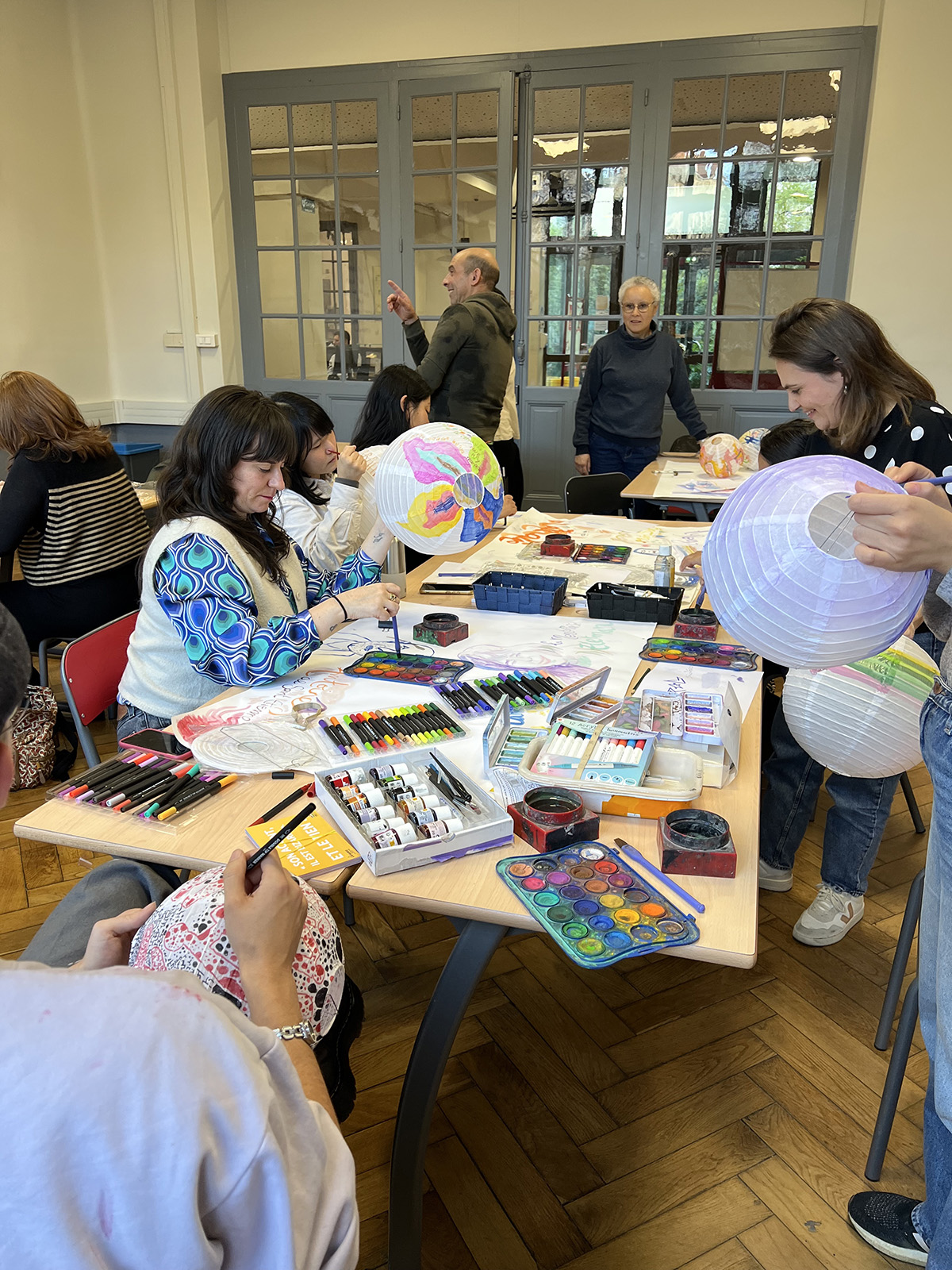
Module 1
Module 1 (compulsory): developing an artistic and cultural project based on the ten words: why and how? 1 day.
– Artistic and cultural outreach to support language learning
– The ‘Caravane des dix mots’: its expertise and philosophy
– Inspiring and inspiring projects
– Developing a project tailored to your organisation
Module 2
Module 2: workshop on raising awareness of linguistic diversity; choose 3 workshops, each lasting 2 hours
Module 3
Module 3: a residency by an artist affiliated with the organisation. The number of hours is to be determined according to the project and the budget.
Full programme: Module 1 + Module 2 + Module 3
Short programme: Module 1 + Module 3
If you’d like to organise just a workshop on linguistic diversity awareness at your organisation, click here!
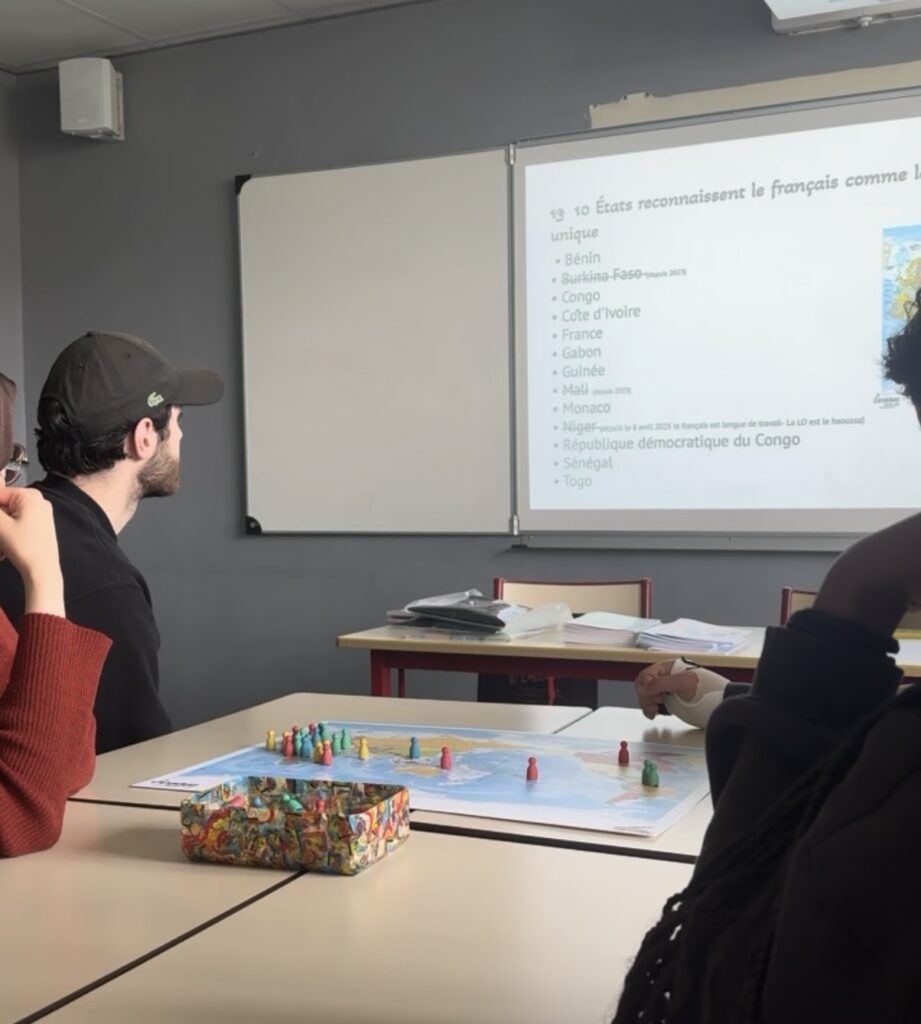
3/ Civic and citizenship education: ‘Exploring and reflecting on languages: diversity and discrimination’
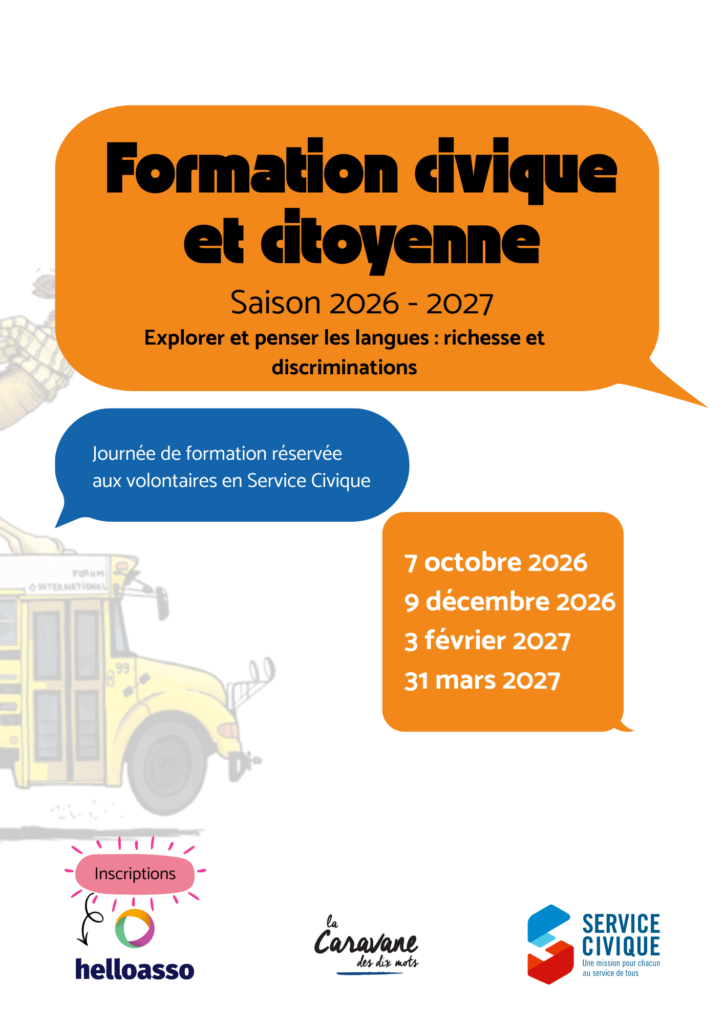
The training course ‘Exploring and Reflecting on Languages: Richness and Discrimination’ is aimed at civic service volunteers.
It takes place over one day and invites participants to examine the concepts of languages, their interrelationships and our relationship with them. The topics covered include: the world’s languages, the Francophonie, linguistic exchanges and language policies in France. These topics are explored through dialogue with participants using activities such as language biographies, dynamic debates and improvisation. In this way, we raise volunteers’ awareness of linguistic and cultural diversity. The training course is held at the Alliance Française in Lyon.
Duration: 1 day (6 hours) – reserved for civic service volunteers
Themes
Linguistic and cultural diversity, the Francophonie, linguistic discrimination, languages, equal dignity of languages, cultural rights.
As participation is a key element of the training, the facilitators adapt their approach to the participants’ responses and level. It is precisely these different backgrounds that make this day so enriching. By celebrating these differences, it is through dialogue that the volunteers get to know one another.
Objectives
– To provide the keys to understanding and grasping the issues surrounding multilingualism, linguistic diversity, linguistic discrimination and the richness of languages
– To raise awareness of these issues
– To encourage dialogue and interaction between volunteers from different organisations
– To encourage participants to share their personal experiences and their own cultural richness
– To spark interest and encourage reflection
– To speak up and take part in activities in front of an audience
– To understand the concept of cultural rights (a key concept for all future involvement in voluntary and cultural organisations)
To gain a better understanding of the impact of this day, here are some testimonials from volunteers who took part in the training.
“I never imagined there were so many languages spoken, especially within a single country!”
“I learnt that there is far more discrimination based on language than I realised.”
“Very interesting, and I was able to stay engaged from start to finish. ”
“The atmosphere during the training was pleasant. I felt no fear of speaking up thanks to the supportive environment.”
“Thank you for everything! I came with some reservations (is this a course that focuses solely on promoting the French-speaking world?), but everything was quickly put to rest! A superb course!”
“The games are really interesting for sharing ideas and understanding.”
Fee agreed under the Civic Service scheme: €50 per participant (to be paid by bank transfer); registration by email.
We operate throughout the Auvergne-Rhône-Alpes region, as well as across France and internationally. Please contact us for further information.
TRAINING FEES
Group organised at the request of an organisation (maximum 15 participants)
Half-day training course: €500
1 day: €1,000
2 days: €2,000
Administration fee: €50
Travel expenses to your premises: if outside the Lyon metropolitan area
Individual
Training sessions are regularly open to individual applicants.
Half-day training session: €50 per person
Full day: €100 per person
Artistic performances at the organisation: €400 per day. It is advisable to get in touch in advance so that we can put together a bespoke project. Please contact us by email and we will arrange a meeting by telephone or video conference to tailor our proposal as closely as possible to your preferences, needs and circumstances.
Training Manager: Christine Perego
EXPLORE THE 2025–2026 REPORT
Available to download as a PDF or to view below: