


What is a caravan?
Since 2003, nearly 100 organisations have taken part in this linguistic adventure by mobilising the inhabitants of their local areas!
The Caravan of Ten Words project is shared by artistic teams and cultural actors across five continents, known as Caravaniers.
United by a shared vision of language as a bridge between citizens and a tool for encountering other cultures, they form a dynamic network committed to reflecting on the challenges facing the French-speaking world and defending and promoting the richness of cultural and linguistic diversity.
How to participate?
The Caravan of Ten Words invites artistic teams from around the world to embark on its linguistic and playful adventure. To find out everything you need to know about how to participate, download the call for projects below.
In short, each year: 40 to 50 teams of Caravaniers
10,000 participants in art workshops • 3,000 DVD box sets distributed
Since 2006, the Caravaniers have met every two years, in the context of the Francophonie Summit, during the International Forums of the Caravans of Ten Words.

The ten words, a shared tool
The ten words create a link between all participants in the Caravan project around the world. A simple and highly effective tool, the ten words are a pretext for individual expression and exchange on a common theme.

The Ten Words initiative is promoted as part of events to promote French around the world, notably French Language and Francophonie Week (France), Francofête (Quebec) and Langue française en fête (Belgium), which take place around 20 March, International Francophonie Day. These ten words are chosen on an annual theme by the various members of OPALE (Organismes francophones de politique et d’aménagement linguistiques), which brings together representatives from France, Belgium, Switzerland, Quebec and the International Organisation of La Francophonie (OIF).

An artist meets the habitants de son territoire
A local artist or cultural actor leads a Caravan of Ten Words project in their area, whether it be a neighbourhood, a town or a region. They implement this project with local residents, meeting them in their own environments, from the most common to the most surprising: a community centre, a school, a prison, a nursery, a retirement home, a theatre, or even in public spaces!

To delve into the meaning of words, beyond their literal definitions, in order to reveal the cultural richness and diversity that every human being carries within them.
Each year, a call for projects is launched in June and closes in September. The projects are reviewed and approved by the Steering Committee of the Caravan of Ten Words in October.

Art workshops to spark expression
The artist acts as a mediator, inviting workshop participants to discover an original and creative means of expression. Writing, slam poetry, theatre, storytelling, dance, visual arts, photography, graffiti, music, etc. – all disciplines are good for playing with words and encouraging people to share their experiences or engage their imagination. This artistic detour helps to remove inhibitions about the English language, by making us aware that language and words belong to us and tell our stories.


A film to give French speakers a voice
Combining street interviews, interviews and images from art workshops held around the world, the Caravane des dix mots film is a veritable mosaic of the ten words, revealing the diversity of definitions, imaginations and cultures. This space for free and creative expression is a window onto the cultural and linguistic diversity of the French-speaking world!

From 2003 to 2015, each Caravanier made their own short documentary film, showcasing the artistic workshops and the voices of the region’s inhabitants. All these films can be viewed on our YouTube channel and on the annual DVDs of the Caravan of Ten Words. Since 2016, Caravaniers have been contributing to a collective film by the Caravane des dix mots. They can also propose and make a short film on a subject related to the French-speaking world and cultural diversity, in the form of a documentary or fiction.
The Tell Me Ten Words scheme
Tell me ten words from a world to come in 2026!
Alunir, anticipation, continuum, dystopian, humanoid, particle, programme, theory, transmute, sidereal
This year, “Dis-moi dix mots” invites us to reflect on the future: 2026 edition
Words are spoken freely, quietly or loudly, with or without an accent. They are recited in speeches, exchanged in debates, performed on stage and leave plenty of room for improvisation.

More information and tools on the ten words (exhibitions, educational sheets, etc.) on the French Ministry of Culture website: dismoidixmots.culture.gouv.fr
Workshops
Art workshops


The Caravan of Ten Words offers art workshops for:
– Initiate a participatory artistic project on the English language
– Encourage participants to express themselves and gain self-confidence
– Prevent school dropout
– Combat illiteracy
– Encourage interaction between participants and cultural dialogue
– Network with other organisations in your area.
The different types of workshops
– The “solo” workshop: see detailed presentation, by discipline and by artist.
– The “pair” workshop: combining disciplines and perspectives, with two artists working together in the same workshop (see detailed presentation).
– The “professional training” workshop: workshops aimed at facilitators/coordinators within your organisation.
Practical details
- Workshop duration: a Caravane workshop consists of six hours of work by an artist with an audience. A workshop project may combine several workshops and several different artists over a given period.
- Material requirements: each travelling artist must bring the necessary equipment for their workshop; it is mandatory to provide a suitable venue for the event.
- Pricing: La Caravane offers sliding-scale rates for organisations with limited budgets. Rates vary depending on the size of your project and the number of workshops planned: contact us for more details. In some cases, travel expenses may apply.
Workshops to raise awareness of linguistic diversity
The linguistic diversity awareness workshops are designed and conceived as spaces for exchange, debate, and the co-construction of knowledge and tools that enable participants to form an informed opinion on linguistic diversity so that they can approach it in their daily lives, at school, and at work in an objective and thoughtful manner.
Three workshops are offered:
– Thinking about and exploring languages
– Am I a French speaker?
– Languages in question
Our workshops are eligible for the Pass Culture and can be booked on Adage.
Contact us so that we can make a pre-booking for you on Adage.
THINKING ABOUT AND EXPLORING LANGUAGES
Linguistic diversity is everywhere: accents, regional varieties, national multilingualism, cross-border contacts, migration patterns… and promoting it represents social, educational, ethical and civic challenges. Indeed, linguistic plurality is often seen as an obstacle, a barrier that hinders mutual understanding and fuels conflict. History shows us that languages can be both instruments and stakeholders in relationships of inequality and domination between individuals and social groups. We offer a workshop that showcases and highlights the plurality of languages and legitimises their use in the public sphere.
AM I FRENCH-SPEAKING?
The Francophonie is characterised by tremendous cultural, religious and linguistic diversity. There are French languages that are vibrant, inventive and constantly evolving, all equally legitimate. This is why we speak of Francophonies in the plural, as opposed to a political and strictly French vision of the French language. The aim is to promote the plurality of French throughout the world.
THE LANGUAGES IN QUESTION
We felt that the “card” format was ideal for conveying the questions we ask ourselves and that concern us, particularly in a world characterised by numerous, multiple and complex forms of mobility. The 24 cards cover a wide range of everyday topics related to languages and linguistic and cultural diversity. The workshop will take place in two stages: the first stage will allow participants to discover the cards and make their first attempts at spontaneous answers to the questions; the second stage will attempt to propose collective answers to the various questions.
Personalised itineraries
If you have a project related to French and linguistic and cultural diversity, and would like support in developing and running an artistic and/or linguistic project, contact us and we can put together a tailor-made programme for you, whatever your organisation and audience.
Three examples to view below:
Workshop Antoine Louisgrand
Collège Alain, St-Fons
Pocket Languages
Hassan Guaid, May 2024
Languages and us
Lycée Lumière
Training courses
Designed by language specialists, these training courses are aimed at all professionals involved in linguistic diversity (teachers, early childhood professionals, extracurricular activity leaders, social centres, municipal staff, civic services, etc.). They aim to support teams in promoting multilingualism and encouraging intercultural exchange.
Linguistic and cultural diversity in the workplace: tools for understanding and taking action


PRESENTATION OF COURSES FOR 2025/2026
Our professional training courses are designed and conceived as spaces for dialogue, debate, and the co-construction of knowledge and tools that enable participants to form an informed opinion on linguistic diversity so that they can approach the professional environment in an objective and thoughtful manner.
Inspired by popular education and social constructivism, our training courses are active and participatory. They are by no means intended to lecture or impose a point of view, but rather to stimulate debate and provide the keys to opening doors, broadening horizons and thinking together.
While the approach aims to transmit knowledge about linguistic and cultural diversity, its primary objectives are to develop interpersonal skills: attentiveness, sensitivity, curiosity, openness and respect for linguistic and cultural diversity; and practical skills: interacting in a multilingual and multicultural environment, recognising and valuing languages, adopting professional attitudes that promote fairness and equal opportunities, and encouraging intercultural dialogue.
To this end, it favours attitudes of questioning, distancing, decentring and relativisation.
Three training courses are available:
– Linguistic and cultural diversity in a professional context: richness and challenges
– Implementing an artistic and cultural project based on the “Ten Words for Me” initiative
– Civic and citizenship training course “Exploring and thinking about languages: richness and discrimination” (reserved for civic service volunteers but adaptable to all types of contexts).
Audience: professionals from all fields: education, socio-cultural, medical and paramedical, justice, media libraries, etc.
Duration: ½ day, 1 day, 2 days or more
All our training courses can be adapted to suit the context and audience. Please contact us if you have specific requirements.
1/ Linguistic and cultural diversity in the workplace: opportunities and challenges
We live in a pluralistic world that is constantly evolving. Linguistic diversity is everywhere: accents, regional varieties, national multilingualism, cross-border contacts, migration patterns… and promoting it represents social, educational, ethical and civic challenges. Indeed, linguistic plurality is often seen as an obstacle, a barrier that hinders mutual understanding and fuels conflict. History shows us that languages can be both instruments and stakeholders in relationships of inequality and domination between individuals and social groups. There is valued multilingualism and stigmatising multilingualism; languages that are popular and languages that are despised, opening the door to all kinds of discrimination against the speakers of these languages. How can linguistic and cultural diversity be made a factor for inclusion and a lever for cohesion? A personal and professional asset?
How can we better understand it in order to better understand each other?
Objectives :
– Discover the challenges of promoting linguistic and cultural diversity
– Become familiar with intercultural approaches
– Adapt your approach to your professional context
– Create and implement a project within your organisation
2/ Implement an artistic and cultural project based on the “Tell me ten words” initiative.
Since 2005, La Caravane des dix mots has been supporting artistic and cultural projects in the Rhône-Alpes region and internationally. Each year, it certifies between 30 and 50 projects in France and around the world, which form the Caravaniers and Caravanières network. The projects are based on the “ten words” initiative, launched each year by the Ministry of Culture and the DGLFLF. The ten words are a pretext for playing with languages and initiating multidisciplinary projects that encourage reflection and encounters through creation.
2026 – Dis-moi dix mots pour un monde à venir
This training course is aimed at all types of organisations wishing to get involved in an artistic project focusing on the French language, intercultural dialogue and linguistic diversity. This training course is structured around several modules in the form of a course.
Module 1 (compulsory): developing an artistic and cultural project based on the ten words: why and how? 1 day.
– Artistic and cultural mediation in language learning
– The Caravan of Ten Words: its expertise and philosophy
– Inspired and inspiring projects
– Developing a project tailored to your organisation
Module 2: workshop to raise awareness of linguistic diversity, 3 workshops to choose from, 2 hours each.
Module 3: intervention by an artist associated with the organisation. The number of hours is to be determined according to the project and budget.
Full course: module 1 + module 2 + module 3
Mini course: module 1 + module 3
If you would like to organise a workshop on linguistic diversity awareness within your organisation, click here!
3/ Civic and citizenship education: “Exploring and thinking about languages: diversity and discrimination”

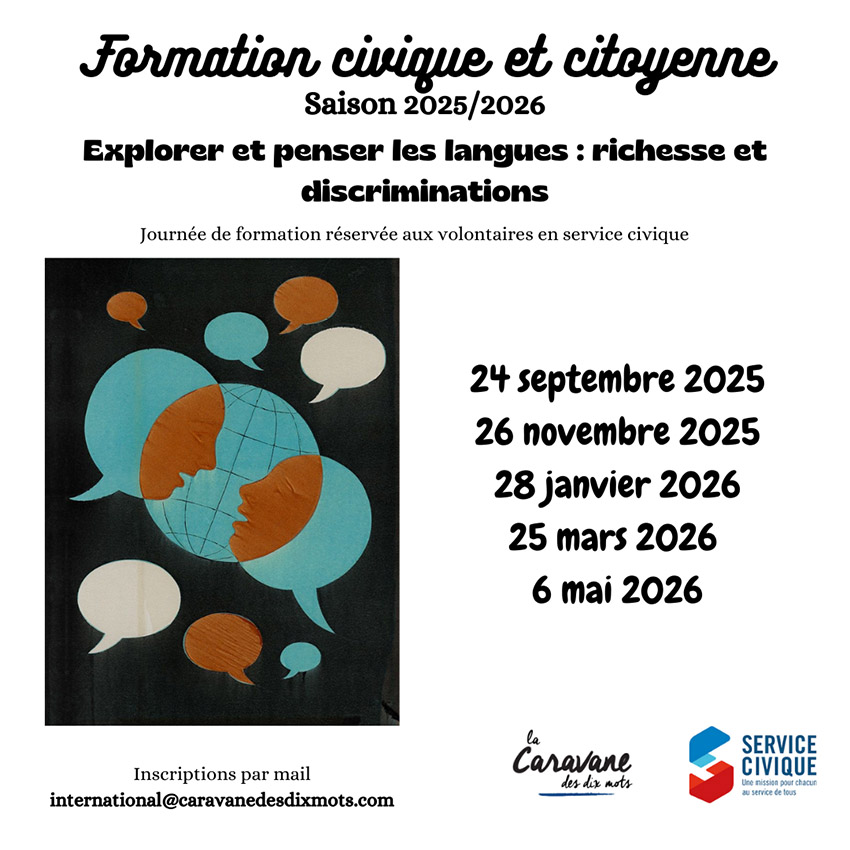
The training course “Exploring and thinking about languages, diversity and discrimination” is aimed at volunteers in civic service. It lasts one day and invites participants to examine the concepts of languages, their relationships and our relationship with them. The topics covered include: the languages of the world, the French-speaking world, language exchanges and language policies in France. These topics are explored in dialogue with participants through activities such as language biographies, moving debates and improvisation. In this way, we raise volunteers’ awareness of linguistic and cultural diversity. The training course is delivered at the Alliance Française in Lyon.
Duration: 1 day (6 hours) – reserved for civic service volunteers
ThemesLinguistic and cultural diversity, Francophonie, linguistic discrimination, languages, equal dignity of languages, cultural rights. Participation is a key element of the training, so the facilitators adapt to the participants’ receptiveness and level. The different profiles are precisely what makes this day so enriching. By valuing these differences, volunteers come together through exchange.
Objectives
– Provide the keys to understanding and appreciating the challenges of multilingualism, linguistic diversity, linguistic discrimination and the richness of languages
– Raise awareness of these issues
– Encourage exchange and interaction between volunteers from different organisations
– Encourage participants to express their personal experiences and cultural richness
– Stimulate interest and questioning
– Encourage participants to speak and take part in activities in front of an audience
– Understand the concept of cultural rights (a key concept for all future associative and cultural endeavours)
To better understand the impact of this day, here are some testimonials from volunteers who participated in the training.
“I had no idea there were so many languages spoken, especially within the same country!”
” I learned that there is much more discrimination than I thought when it comes to language.”
“Very interesting, and I was engaged from start to finish.”
” The atmosphere during the training was pleasant. There was no fear of speaking up in such a supportive environment.”
“Thank you for everything! I came with some apprehensions (is this a training course that only promotes the French language?), but everything was quickly resolved! Superb training! ”
“The games are really interesting for sharing and understanding.”
Civic service agreed rate: €50 per participant (to be paid by bank transfer), registration by email.
We operate throughout the Auvergne-Rhône-Alpes region, as well as in France and internationally. Contact us for more information.
TRAINING PRICES
Group on request from an organisation (maximum 15 participants)
Half-day training session: €500
Full day: €1,000
Two days: €2,000
Administrative fees: €50
Travel expenses to your organisation: if outside the Lyon metropolitan area
Individual
Training sessions are regularly open to individual applicants.
Half-day training: €50/person
Full day: €100/person
Artistic interventions within the organisation: €400/day
It is advisable to contact us in advance so that we can develop a tailored programme. Contact us by email and we will arrange a telephone or video conference meeting to tailor our proposal to your specific requirements, needs and circumstances.
Training Manager: Christine Perego
DISCOVER THE 2025-2026 DOSSIER
Download as a PDF or view below: